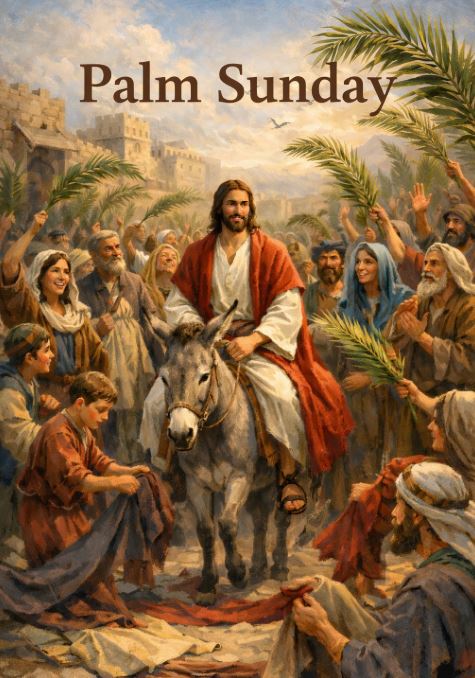
Palm Sunday is one of the most meaningful days on the Christian calendar. It is observed on the Sunday before Easter and marks the beginning of Holy Week—the final week of Jesus Christ’s earthly ministry leading to His crucifixion and resurrection. On this day, believers remember and reflect on Jesus’ triumphal entry into Jerusalem, an event recorded in all four Gospels (see Gospel of Matthew 21:1–11, Gospel of Mark 11:1–11, Gospel of Luke 19:28–44, and Gospel of John 12:12–19).
As Jesus entered Jerusalem, He did not come as an earthly conqueror or military leader. Instead, He rode on a donkey, fulfilling the Old Testament prophecy found in Zechariah 9:9: “Rejoice greatly, O daughter of Zion; shout, O daughter of Jerusalem: behold, thy King cometh unto thee: he is just, and having salvation; lowly, and riding upon an ass, and upon a colt the foal of an ass…”
The crowds who gathered that day laid their garments on the road and waved palm branches while shouting, “Took branches of palm trees, and went forth to meet him, and cried, Hosanna: Blessed is the King of Israel that cometh in the name of the Lord.” (John 12:13). In Jewish culture, palm branches symbolized victory, celebration, and triumph. They were often used during great feasts such as the Feast of Tabernacles. By waving palm branches, the people were openly declaring their belief that Jesus was the long-awaited Messiah.
However, many of those shouting “Hosanna” misunderstood the kind of Savior Jesus came to be. They expected deliverance from Roman oppression, a political king who would restore Israel’s national power. Jesus, instead, came to bring salvation from sin. His kingdom was not of this world (John 18:36), and His mission was far greater than political freedom—it was eternal redemption.
Palm Sunday powerfully reveals the humility of Christ. While earthly kings rode horses as symbols of strength and conquest, Jesus chose a donkey, a symbol of peace and servanthood. Philippians 2:7–8 reminds us that Jesus “But made himself of no reputation, and took upon him the form of a servant, and was made in the likeness of men: And being found in fashion as a man, he humbled himself, and became obedient unto death, even the death of the cross.” From the very beginning of Holy Week, Jesus demonstrated that His path was one of sacrifice.
This joyful celebration also foreshadowed the suffering that was to come. Jesus knew that the same city welcoming Him with praise would soon cry out, “…saying, Crucify him, crucify him” (Luke 23:21). Yet He entered Jerusalem willingly, fully aware of the pain, betrayal, and death that awaited Him. This was not a tragic accident of history—it was God’s divine plan for the salvation of mankind. Isaiah 53:5 declares, “But he was wounded for our transgressions, he was bruised for our iniquities: the chastisement of our peace was upon him; and with his stripes we are healed.”
It is both sobering and amazing to consider how quickly the hearts of people changed. In less than a week, the crowd’s praise turned into rejection. Still, Jesus remained faithful. Being without sin, He became the perfect sacrifice for our sins (1 Peter 2:22–24). Through His death and resurrection, forgiveness and eternal life were made available to all who believe.
Palm Sunday is not just a historical event—it is a call for personal reflection. We must ask ourselves: Are we truly welcoming Jesus as King of our hearts, or only praising Him when it suits our expectations? Romans 10:9 reminds us of God’s promise: “That if thou shalt confess with thy mouth the Lord Jesus, and shalt believe in thine heart that God hath raised him from the dead, thou shalt be saved.”
If you do not know Christ, or if you have drifted away from Him, Palm Sunday is a perfect time to return. God’s grace is still available. His mercy still reaches the broken and the repentant. The Bible assures us in 1 John 1:9, “If we confess our sins, he is faithful and just to forgive us our sins, and to cleanse us from all unrighteousness.”
In conclusion, Palm Sunday reminds us that Jesus is both King and Savior—humble, obedient, and victorious. Though He entered Jerusalem knowing the cross awaited Him, He did so out of love for us. My prayer is that we will not merely wave palms in celebration, but surrender our lives in obedience. May God truly help and bless you as you place your faith fully in Him.
I thank you for reading my blog. I do not claim to be any expert or affiliated with any religious organization. All I can say is that I’m affiliated with my Lord Jesus Christ. This is one man’s opinion and observations. My hope is I stirred up some thoughts for you to think about. There is one place where we can find all the answers to life. That road map is Commonly known as the Bible. If you want the answers to life all you have to do is read. If you would like me to pray with you or want to send a comment, please email me at Bob.L@magnificentpromises.com
For God so loved the world that he gave his only begotten son, that whosoever believeth in him shall not perish but have everlasting life. John 3:16