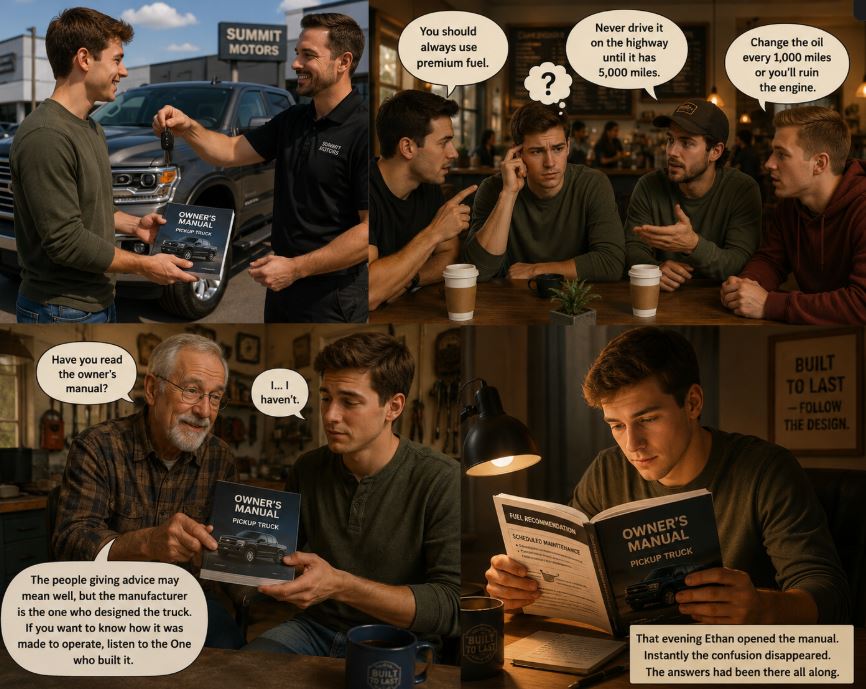
A young man named Ethan finally bought the pickup truck he had dreamed about for years. It was beautiful—loaded with technology, powerful, and built to last. The salesman handed him the keys along with a thick owner’s manual.
A few weeks later, Ethan met some friends at a local coffee shop. Each friend had advice about how to care for the truck.
One said, “You should always use premium fuel.” Another insisted, “Never drive it on the highway until it has 5,000 miles.” A third declared, “Change the oil every 1,000 miles or you’ll ruin the engine.” Everyone sounded confident. Before long, Ethan was confused. Each opinion contradicted the others.
Finally, his grandfather, a retired mechanic, smiled and asked, “Have you read the owner’s manual?” Ethan admitted he hadn’t.
His grandfather handed it back to him and said, “The people giving advice may mean well, but the manufacturer is the one who designed the truck. If you want to know how it was made to operate, listen to the One who built it.”
That evening Ethan opened the manual. Instantly the confusion disappeared. The answers had been there all along.
The Christian life is much the same. We hear opinions from television, social media, culture, even from sincere religious people. Traditions have their place, but when they disagree with God’s Word, there is only one authority we can trust—the One who created us and redeemed us.
Throughout church history, one question has surfaced repeatedly: Should Christians primarily follow church teaching & doctrine or the clear teaching of Scripture? While every biblical church has beliefs and practices that help maintain order, the Word of God must always remain the highest authority. Churches are strongest when their doctrines are built upon Scripture rather than Scripture being made to fit tradition.
The Apostle Paul reminded Timothy of the importance of God’s Word when he wrote: “All scripture is given by inspiration of God, and is profitable for doctrine, for reproof, for correction, for instruction in righteousness.“ (2 Timothy 3:16, KJV)
Notice that Paul did not point Timothy to human traditions or religious customs. He pointed him to Scripture. God’s Word is the foundation for doctrine, correction, and spiritual growth.
The Bible Reveals the Heart of God.
The Bible is much more than a collection of historical accounts or religious teachings. It is God’s revelation of Himself to mankind. Within its pages we discover His holiness, mercy, justice, grace, and His great love for sinners.
Perhaps no verse expresses this truth more clearly than: “For God so loved the world, that he gave his only begotten Son, that whosoever believeth in him should not perish, but have everlasting life.“ (John 3:16, KJV)
This single verse summarizes the Gospel. God’s love motivated Him to send His Son so that all who believe in Him can receive eternal life. That message should always be at the center of biblical teaching.
Likewise, Romans 10:9-10 teaches that salvation comes through faith in Jesus Christ: “That if thou shalt confess with thy mouth the Lord Jesus, and shalt believe in thine heart that God hath raised him from the dead, thou shalt be saved.“ (Romans 10:9, KJV)
These are not church traditions—they are eternal truths revealed by God Himself.
Grace, Not Human Effort
Churches often establish guidelines to encourage godly living, and there is certainly value in biblical standards. However, problems arise when human rules are treated as though they are equal to—or greater than—the Word of God.
The Bible is crystal clear about salvation: “For by grace are ye saved through faith; and that not of yourselves: it is the gift of God: Not of works, lest any man should boast.“ (Ephesians 2:8-9, KJV)
No amount of church attendance, religious ceremonies, or good deeds can save a sinner. Salvation is entirely the work of God’s grace through faith in Jesus Christ.
Imagine a man drowning in the ocean. A lifeguard dives in, rescues him, and carries him safely to shore. The rescued man cannot claim credit for saving himself. His rescue depended entirely upon the lifeguard. In the same way, salvation depends completely upon Jesus Christ. We simply place our faith in the One who has already done the saving.
Knowing God Personally
Teaching the Bible does more than provide information—it introduces us to the living God. Jesus prayed: “Sanctify them through thy truth: thy word is truth.“ (John 17:17, KJV)
As believers read and study Scripture, they begin to understand God’s promises, His faithfulness, and His will for their lives. Christianity is not merely following a list of regulations; it is walking daily with the Lord.
Consider two children growing up in different homes. One obeys his father only because he fears punishment. The other obeys because he knows his father’s love and trusts his wisdom. Both may perform the same actions, but only one has a genuine relationship.
Likewise, Christians who know only religious rules often serve out of obligation. Those who know God through His Word serve out of love, gratitude, and faith.
Test Every Teaching by Scripture
The believers in Berea provide a wonderful example for every Christian today. “These were more noble than those in Thessalonica… in that they received the word with all readiness of mind, and searched the scriptures daily, whether those things were so.“ (Acts 17:11, KJV)
The Bereans did not blindly accept every message they heard. Even though the Apostle Paul was preaching, they examined the Scriptures to ensure his teaching agreed with God’s Word.
Every pastor, teacher, denomination, and church should welcome this same standard today. Biblical teaching should never fear biblical examination.
Building a Faith That Lasts
Church traditions may change over time, but God’s Word never changes. “The grass withereth, the flower fadeth: but the word of our God shall stand for ever.“ (Isaiah 40:8, KJV)
When believers build their lives upon Scripture, they develop a faith that can withstand hardship, temptation, and false teaching. The Bible provides wisdom for daily living, comfort in suffering, hope during trials, and assurance of eternal life through Christ.
Church doctrine has its proper place when it faithfully reflects Scripture. However, every doctrine, practice, and tradition must always remain subject to God’s Word. The Bible—not human opinion—is the Christian’s final authority.
May we be people who love God’s Word, study it diligently, teach it faithfully, and live it daily. As Jesus declared, “Thy word is truth.” There is no firmer foundation upon which to build our lives.
The Bible is our Creator’s instruction book for life. As David declared, “Thy word is a lamp unto my feet, and a light unto my path.“(Psalm 119:105, KJV). And Jesus said, “Heaven and earth shall pass away, but my words shall not pass away.“(Matthew 24:35, KJV).
Faith doesn’t have to rest on opinions, personalities, or traditions. Build it on the unchanging Word of God—read it, believe it, live it. When every other voice fades, God’s Word will remain true, always guiding you to the Savior, Jesus Christ, who alone offers eternal life.
There’s no better time than now to start living as if it were your last day on earth. All you need is to take a moment to pray… Tell God you believe His Son, Jesus, paid for your sins and rose from the grave. Let Him know you’re sorry and want to live for Him. He will forgive your sins and mistakes, give you everlasting life with Him, and place His Spirit deep within your heart. 1 John 1:9 says, “If we confess our sins, he is faithful and just to forgive us our sins, and to cleanse us from all unrighteousness.” and Romans 10:9 tells us, ”that if you confess with your mouth Jesus as Lord, and believe in your heart that God raised Him from the dead, you will be saved;
May God Bless you. Bob
Thanks for taking the time to read my blog. I don’t claim to be an expert or connected to any religious organization. My only affiliation is with my Lord Jesus Christ. What I’ve shared here is just one man’s opinion and observation. I hope it’s given you something to think about. I believe there’s one place where we can find all the answers to life, and that guide is known as the Bible. If you’re seeking those answers, all you need to do is read. If you’d like me to pray with you or share your thoughts, feel free to email me at Bob.L@magnificentpromises.com.
For God so loved the world that he gave his only begotten son, that whosoever believeth in him shall not perish but have everlasting life. John 3:16